
IT outsourcing means hiring an outside company to handle your technology, so you are not doing it yourself, not waiting on a friend who “knows computers,” and not hoping nothing breaks on a Friday afternoon before a holiday weekend.
For small businesses in Bergen County, Hudson County, and Passaic County, outsourcing IT has become the default approach for companies that want their technology to actually work without building an internal IT department to make it happen. This guide covers what IT outsourcing includes, what it costs, how the process works from first call to active service, and the questions you should ask any provider before signing an agreement.
If you have been searching for IT outsourcing in NJ and want to understand what you are actually buying before you start talking to providers, this is the right place to start.
Why Small Businesses in NJ Outsource Their IT
The decision usually comes from one of three places.
The owner is handling IT themselves and it is eating time they do not have. The business has been relying on a break-fix arrangement, calling someone when things break, and the bills and downtime are adding up. Or the business is growing, adding employees or locations, and the current setup is not keeping pace.
All three situations have the same underlying problem: technology is taking time and attention away from the actual business.
According to SCORE’s 2024 research, 48% of small business owners listed outsourcing more functions as a planned initiative in their 2025 to 2026 growth strategy. The reason is not just cost. Deloitte’s Global Outsourcing Survey found that only 34% of executives now cite cost reduction as their primary reason for outsourcing, down from 70% in 2020. What replaced it is access to specialized talent, digital capabilities, and services that would be impractical to build internally.
For a 10-person accounting firm in Hackensack or a 15-person contractor in Paramus, there is no realistic path to employing a cybersecurity specialist, a network engineer, and a help desk technician. Outsourcing is what makes those capabilities accessible without the overhead of a full IT department.
What IT Outsourcing for Small Businesses Actually Includes
When people search for IT outsourcing in NJ, they are usually looking for what the industry calls managed IT services, a monthly arrangement where a provider takes ongoing responsibility for your technology rather than just fixing things after they break.
Here is what that typically covers.
Help Desk Support for Your Employees
When an employee cannot log in, cannot access a shared drive, or runs into an error they do not understand, they call the help desk. A technician diagnoses the issue and resolves it, usually remotely, without pulling you away from whatever you were doing.
For businesses with five to 25 employees, this alone recovers a meaningful amount of time each week.

Proactive Network Monitoring
The best IT support is the kind that catches problems before they affect your business. A managed IT provider monitors your network around the clock, flagging hardware that is running hot, connections that are degrading, or backup processes that have failed silently.
A server issue that gets caught at 2 a.m. on a Tuesday stays a minor issue. The same problem left undetected becomes a data loss event Wednesday morning when your team shows up.
Cybersecurity
For small businesses in NJ, cybersecurity is not separate from IT support. It is built into it. According to Verizon’s 2025 Data Breach Investigations Report, ransomware was present in 88% of SMB breaches, more than double the rate seen at larger organizations, with the median ransom payment reaching $115,000.
A managed IT provider watches for phishing attempts, unusual login behavior, and early indicators of a breach. When something suspicious surfaces, the response happens before it becomes a crisis. This is part of what makes the relationship function like a virtual CTO or CIO for businesses that do not have internal IT staff.
Backup and Disaster Recovery
Verified, tested backups are what separate a ransomware incident from a business-ending event. A managed IT provider sets up automated backups, stores them offsite or in the cloud, and runs recovery tests to confirm the data can actually be restored when needed.
Software Updates and Patch Management
Outdated software is a primary entry point for cyberattacks. A managed IT provider handles updates on a schedule, typically during off-hours, and verifies that patches apply correctly without breaking other systems.
Strategic Planning and IT Consulting
Beyond day-to-day support, a good managed IT provider helps you plan ahead. What hardware needs to be replaced in the next 12 months? Is your infrastructure going to support five new hires? Are there licensing costs you are paying for tools you no longer use? This is the IT consulting function that turns your provider from a vendor into a partner.
What IT Outsourcing Costs for a Small Business in NJ
Most managed IT providers in NJ price their services on a per-user or per-device monthly basis. According to Brightworks Group’s managed IT pricing research, most small businesses pay between $100 and $250 per employee each month for complete IT support, with businesses of 10 to 50 employees typically paying between $1,000 and $5,000 per month total covering monitoring, security, backup, and support.
That number looks different when you set it against the cost of handling IT another way.
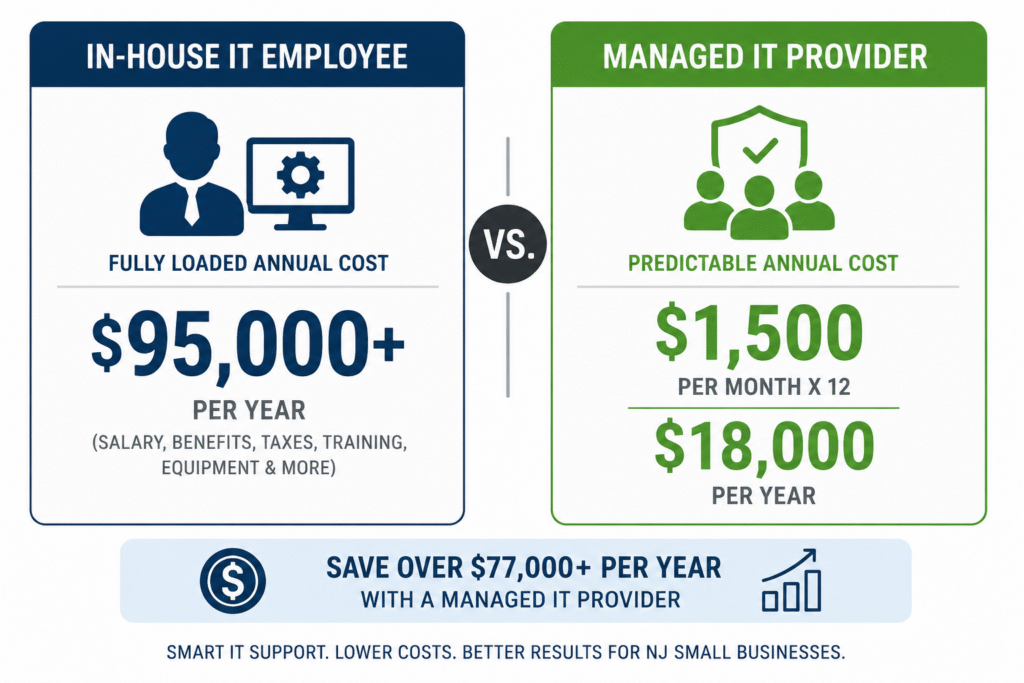
Research on MSP vs. in-house IT costs consistently finds that the total cost of managed IT services runs 50 to 60% lower than the fully loaded cost of a full-time IT employee, while delivering significantly more coverage, expertise, and capability than a single person can provide.
A systems administrator in the New York metro area earns between $96,000 and $140,000 in base salary. Add benefits, payroll taxes, equipment, software licenses, and the cost of replacing them when they leave, and a single in-house IT hire costs most small businesses well over $150,000 per year. For that money, you get one person with one set of skills, one schedule, and no coverage when they are sick or on vacation.
A managed IT arrangement gives you an entire team of specialists for a fraction of that. Help desk technicians, network engineers, cybersecurity professionals, and strategic consultants, all included in a predictable monthly fee.
How the IT Outsourcing Process Works at Coban Computer Solutions
If you are evaluating managed IT services in NJ, understanding what the onboarding process actually looks like helps you set expectations and make a better decision.
Here is how Coban approaches it.
Step 1: The Discovery Call
Everything starts with a conversation. Not a sales pitch, a discovery call to understand your current setup, your pain points, and whether there is a good fit. What does your network look like? How many employees do you have? What problems are you running into most often? How are you currently handling IT?
This call gives Coban enough context to understand your environment and tell you honestly whether the engagement makes sense.
Step 2: The On-Site Network Assessment
If the discovery call confirms a fit, the next step is a network assessment. Coban meets you on-site to get a clear picture of your infrastructure: what hardware you have, how old it is, what software you are running, how your backups are configured, and where the security gaps are.
This is not a formality. The network assessment drives the proposal. It is how Coban identifies what needs to be addressed immediately, what can be phased in, and what your actual risk exposure looks like before anything is signed.
Step 3: The Proposal
The assessment gives Coban everything needed to put together a proposal. For most small businesses, Coban bundles cybersecurity, managed IT, disaster recovery, and help desk support into a single monthly arrangement covering nearly 40 individual services.
For businesses with more specific needs, lighter custom proposals are available. The goal is not to sell a standard package; it is to match the service level to what your business actually requires.
Step 4: Onboarding and Transition
Once an agreement is in place, Coban handles the transition. Your team gets a point of contact for support. Systems get documented. Monitoring gets configured. If there are immediate issues identified during the network assessment, those get addressed first.
The transition is designed to be quiet from your team’s perspective. The work happens in the background. What your employees notice is that things start working better.
The Difference Between IT Outsourcing and Break-Fix Support
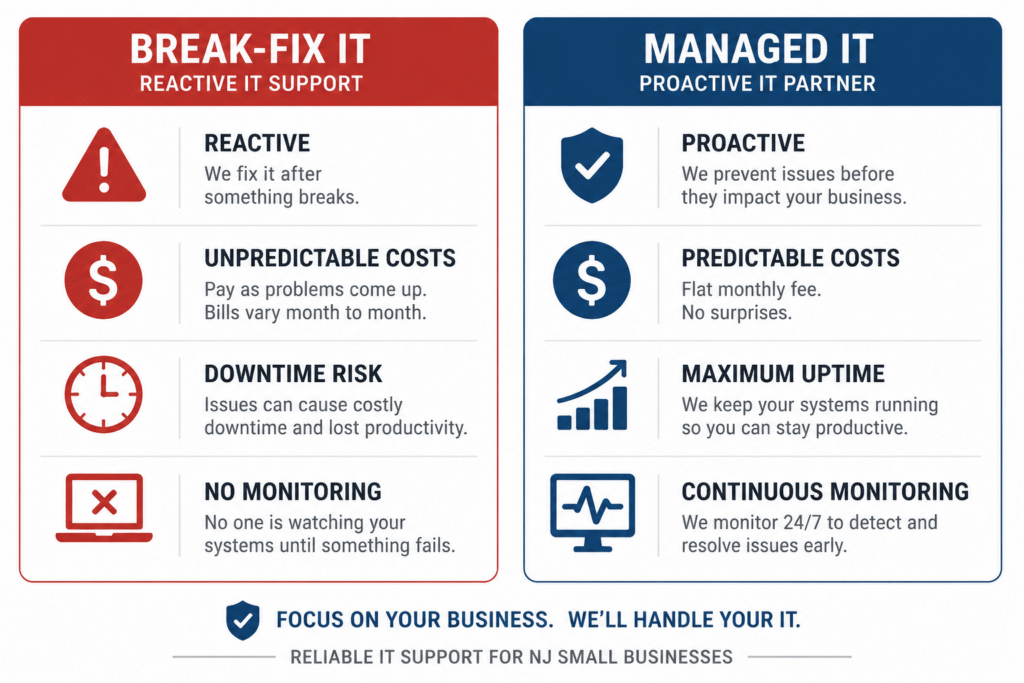
Most small businesses in Bergen County that have not outsourced IT formally have experienced break-fix support at some point. That is the model where you call someone when something breaks and pay by the hour for them to fix it.
Break-fix has two structural problems.
The incentive is backwards. A break-fix provider makes more money when things break more often. There is no financial reason for them to prevent problems.
It is entirely reactive. There is no monitoring, no scheduled maintenance, no patch management, no backup verification. You find out your backup has been failing for three months when you actually need to restore from it.
Managed IT flips that model. You pay a predictable monthly fee and your provider is financially incentivized to keep things running well, because their time is most profitable when your systems are stable. Prevention is built in because it is in everyone’s interest.
For most small businesses in NJ running more than a handful of employees, the managed model costs less over 12 months than the combination of break-fix bills, lost productivity, and the time you spend managing the relationship with a break-fix provider.
Signs Your Business Is Ready to Outsource IT
Not every business is at the same point in this decision. Here are the clearest signals that outsourcing IT would make a material difference.
You or someone on your team is handling IT. If the owner is also the de facto IT person, every hour spent troubleshooting is an hour not spent on clients, growth, or the work that actually requires you.
You are getting hit with unpredictable IT bills. Break-fix arrangements produce unpredictable costs that are hard to budget for. A managed monthly fee is predictable. You know what IT costs every month.
Employees are losing time to technical issues. If your team works around problems, improvises because something is not functioning right, or waits days for issues to be resolved, that is lost productivity compounding weekly.
You do not have a clear cybersecurity posture. If you could not describe your defenses against phishing or ransomware in plain terms, or if you are not certain your backups are running, those gaps need to be closed. A managed IT provider closes them.
You are growing. Adding employees, adding locations, adding software. Growth creates IT complexity. Getting ahead of it is easier than catching up after problems compound.
What to Ask an IT Outsourcing Provider in NJ Before You Sign
The wrong managed IT provider is worse than no provider. Here are the questions that separate a good fit from a bad one.
Do you do a network assessment before proposing? Any provider who proposes a price before understanding your environment is guessing. A real assessment is the baseline.
What is your response time commitment, in writing? Ask to see the service level agreement. Response times should be tiered by severity, and the commitments should be specific, not “as fast as possible.”
How do you handle cybersecurity? Monitoring and antivirus are a starting point, not a complete answer. Ask specifically about endpoint detection and response, email filtering, and what happens when a threat is detected.
Do you test backups? Backup monitoring is not the same as backup testing. A monitored backup that has never been restored is an untested backup. Ask when they last ran a recovery test for a client.
Who is my point of contact? You should have a named person or a small team who knows your environment, not a ticket queue that routes to whoever is available.
What is not included? Read the contract. Hardware replacement, after-hours support, and on-site visits are sometimes excluded from flat-fee arrangements. Know what triggers an additional charge before you sign.
Frequently Asked Questions About IT Outsourcing in NJ
What is the difference between IT outsourcing and managed IT services?
They are often used interchangeably, but managed IT services specifically refers to the ongoing, proactive model where a provider takes continuous responsibility for your technology. IT outsourcing is the broader category that includes both managed services and project-based or break-fix arrangements. For most small businesses in NJ, managed IT services is the form of outsourcing that makes the most sense.
How long does it take to transition to a managed IT provider?
It depends on the complexity of your environment. A small business with 10 to 15 employees and a straightforward setup can typically be onboarded within two to four weeks. Larger or more complex environments take longer. A good provider will give you a realistic timeline after the network assessment, not before it.
Can I outsource IT if I already have an internal IT person?
Yes. This is called co-managed IT. Your internal person handles day-to-day user contact and maintains close familiarity with the business, while the managed IT provider handles cybersecurity, after-hours monitoring, specialized projects, and backup. It is often more cost-effective than hiring a second internal employee.
What happens if something goes wrong after hours?
Ask this question directly to any provider you are evaluating. After-hours coverage varies significantly. Some providers include 24/7 monitoring and response in their base plans; others charge extra for it or only cover critical issues. Understand exactly what “after hours” coverage means before you sign.
Is IT outsourcing a good fit for businesses with just a few employees?
Size matters less than complexity and risk. A five-person business processing client payments, storing sensitive records, and relying on cloud software has meaningful IT risk. The right managed IT arrangement scales to your actual environment. Most providers have entry-level plans designed for small teams.
The Bottom Line
IT outsourcing for NJ small businesses is not a complicated concept. You hand off responsibility for your technology to a team that does it full time, and you get back the time and energy you were spending on it.
The process at Coban starts with a discovery call, moves to an on-site network assessment, and produces a proposal that matches your actual needs. No cookie-cutter packages, no guesswork about what your environment requires.
Coban Computer Solutions has been providing managed IT and outsourced IT support to small businesses across Bergen, Hudson, and Passaic Counties since 1992. If you want to understand what your current IT situation actually looks like and where the gaps are, contact us to schedule a network assessment.