Most small business owners in Bergen County did not get into business to think about IT. They got into business to run an accounting practice in Hackensack, a law office in Paramus, a construction company in Wyckoff, a medical practice in Ridgewood.
But the IT decisions, or the absence of them, follow every one of those businesses around whether the owner is thinking about them or not. Ransomware does not check whether you have time to deal with it. Phishing emails do not wait until your slow season. A server crash does not ask if you are ready.
This post covers the IT terms that come up most often when small businesses in NJ sit down with a managed IT provider for the first time. Not to impress you with technical vocabulary, but because understanding what these things actually are is the first step toward understanding whether your business is protected from them.
Cybersecurity
Cybersecurity is the practice of protecting your business’s computers, networks, and data from unauthorized access, damage, or theft. For a small business in NJ, it is not an IT department concern. It is a business continuity concern.
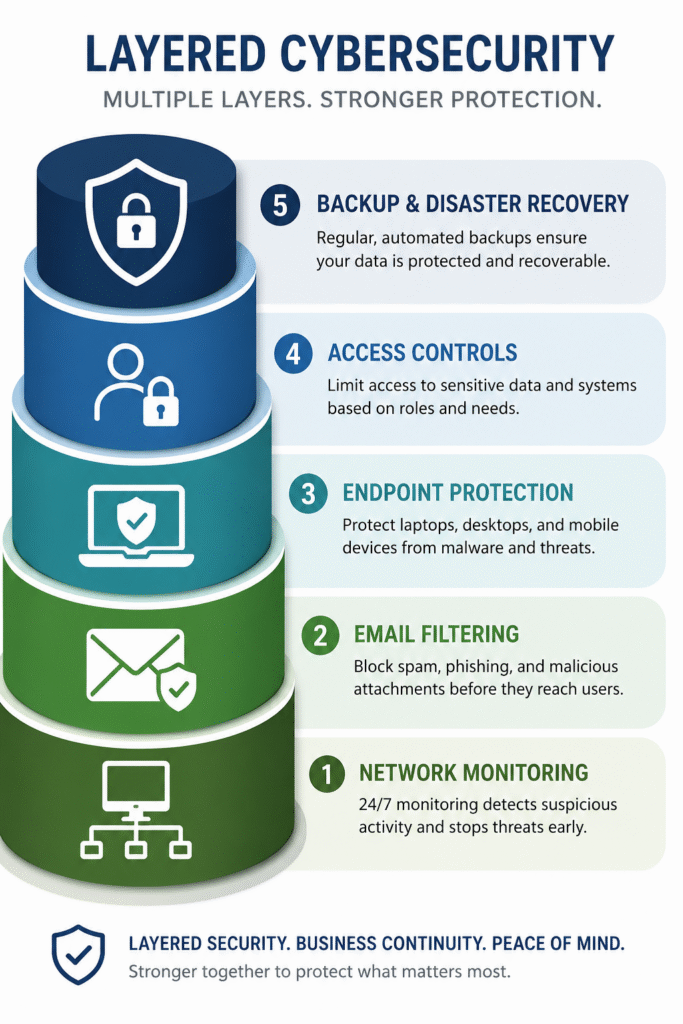
The scope of what cybersecurity covers has expanded significantly. It now includes email protection, network monitoring, employee access controls, software update management, endpoint protection, and incident response planning. No single tool covers all of it. A managed IT provider builds layered defenses across all of them.
The cost of weak cybersecurity is not theoretical. According to the FBI’s IC3 2024 Annual Report, total reported cybercrime losses in the United States reached $16.6 billion in 2024, a thirty-three percent increase from 2023. Small businesses absorb a disproportionate share of those losses because they are accessible targets with limited defenses.
Coban’s cybersecurity services for NJ small businesses are built around layered protection: monitoring, endpoint security, email filtering, and response planning, not a single tool sold as a complete solution.
Cyber Risk
Cyber risk is the probability that a cyberattack or data incident will affect your business, multiplied by the cost if it does. Every business has cyber risk. The question is whether it has been assessed and managed, or whether it is just sitting there unaddressed.
For small businesses in NJ, the most significant cyber risks are ransomware, phishing, and data loss from hardware failure. Each one has a different probability and a different cost profile, and each one requires a different control.
A network assessment from a managed IT provider quantifies your specific cyber risk: which systems are exposed, which gaps are largest, and which controls would reduce your risk most efficiently. That is the starting point for a real cybersecurity posture, not a sales conversation about software packages.
Phishing
Phishing is a cyberattack that tricks an employee into clicking a malicious link, opening a dangerous attachment, or entering credentials into a fake website. It is the entry point for the majority of all cyberattacks.
CISA reports that over ninety percent of cyberattacks globally begin with phishing as the initial vector. For small businesses, the threat is direct: an employee receives an email that looks like it is from a vendor, a bank, or Microsoft, clicks a link, and hands an attacker access to your network.
AI has made phishing significantly harder to spot. Phishing emails that were once easy to identify by poor grammar and odd formatting are now indistinguishable from legitimate messages. The median time for users to click on a phishing simulation link is 21 seconds, according to Verizon’s research, which means training alone is not sufficient defense.
Effective protection combines email filtering to catch suspicious messages before they reach the inbox, employee awareness training to improve detection rates, and multi-factor authentication to limit the damage if credentials are compromised anyway.
Ransomware
Ransomware is malicious software that encrypts your business files and demands payment to restore access. It is the most disruptive cyberattack a small business can face, and it has become more common, not less.
Verizon’s 2025 Data Breach Investigations Report found that ransomware was present in eighty-eight percent of SMB breaches, more than double the rate at larger organizations. The median ransom payment reached $115,000. That does not include recovery costs, downtime, or client fallout.
The defenses that matter most against ransomware are verified backups, network segmentation, endpoint detection, and email filtering. Verified means tested. A backup that has never been restored is not a backup you can rely on.
Coban’s data backup services for NJ small businesses include automated offsite backups and regular restoration testing, specifically because untested backups fail when businesses need them most.
Disaster Recovery
Disaster recovery is the plan that gets your business operational again after a major IT failure, whether the cause is ransomware, hardware failure, fire, flood, or human error.
Backup is a component of disaster recovery. It is not the same thing. A backup gives you data to restore from. A disaster recovery plan answers the questions that come after: which systems come back online first, in what order, how long it takes, who is responsible for each step, and how you communicate with clients while the recovery is in progress.
Small businesses in Bergen County that have never tested their disaster recovery plan often discover during an actual incident that the plan they thought they had does not work the way they expected. The network assessment that Coban performs at the start of every new client relationship evaluates disaster recovery readiness as a specific line item, not an afterthought.
Endpoint Detection and Response (EDR)
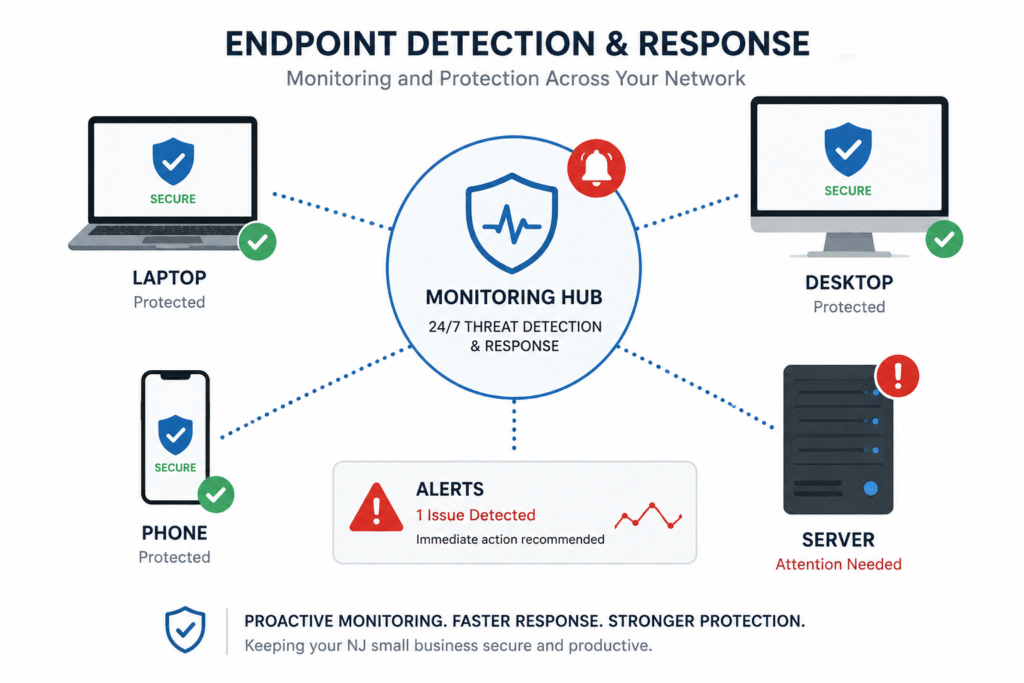
An endpoint is any device connected to your network: laptops, desktops, servers, mobile phones used for work, tablets. Endpoint Detection and Response, commonly abbreviated EDR, is the security tool that monitors each of those devices in real time for signs of malicious activity.
Traditional antivirus software compares files against a list of known threats. EDR goes further. It watches behavior: what processes are running, what files are being accessed, what network connections are being made. When something looks wrong, EDR can isolate the device automatically, stop the threat from spreading, and alert your IT provider before the damage compounds.
For a small business with 10 to 25 employees and multiple devices on the network, EDR is the difference between catching a breach in its early stages and finding out about it weeks later when the damage is done. It is a standard component of Coban’s managed IT services for NJ small businesses.
Cloud Computing
Cloud computing means storing and accessing data and applications over the internet rather than on a physical server in your office. For most small businesses in NJ, cloud computing is already part of daily operations, whether they think of it that way or not.
Microsoft 365 is cloud computing. QuickBooks Online is cloud computing. Google Drive is cloud computing. If your team accesses files or applications from outside the office, through a browser or a VPN, that is cloud computing.
The business advantages are real: access from anywhere, reduced hardware dependency, and infrastructure that scales with your headcount rather than requiring a hardware upgrade every time you add employees. The risks are also real: cloud accounts can be compromised if access controls are weak, cloud platforms occasionally experience outages, and data stored in the cloud still needs to be backed up independently.
A managed IT provider helps you configure cloud environments securely, manage user access properly, and ensure your cloud-based data is covered by a backup plan that actually works.
Microsoft 365
Microsoft 365 is the cloud-based productivity suite that includes Outlook email, Word, Excel, PowerPoint, Teams, and SharePoint. It is the most widely used business software platform among small businesses, and it is also one of the most targeted by cybercriminals.
Microsoft remains the most impersonated brand in phishing attacks, with attackers routinely sending fake Microsoft login pages to harvest credentials. Microsoft 365 accounts without multi-factor authentication are a primary target.
Beyond security, Microsoft 365 requires active management to get full value. Licenses need to be sized correctly. Permissions need to be configured. Teams environments accumulate clutter without governance policies. OneDrive needs to be set up to sync properly across devices.
Coban manages Microsoft 365 environments for small businesses across Bergen, Hudson, and Passaic Counties as part of the managed IT services relationship, which means licenses, configuration, and security settings are handled and monitored, not set once and forgotten.
Artificial Intelligence in IT
AI is increasingly present in both the tools that protect small businesses and the tools that attackers use against them. Understanding both sides matters.
On the defensive side, AI powers the behavioral analysis in EDR tools, the filtering logic in email security platforms, and the anomaly detection in network monitoring systems. These tools identify threats faster and more accurately than rule-based systems because they learn from patterns rather than relying on static lists.
On the offensive side, AI has made phishing attacks significantly more convincing. AI-generated phishing emails now achieve open rates far higher than traditionally written attacks by eliminating the grammatical and formatting errors that trained employees once used to identify suspicious messages.
For small businesses in NJ, the practical implication is that defenses need to keep pace. An IT provider that is not using AI-augmented security tools is working with a toolset that is already behind the current threat environment.
The ROI of Managed IT Services for NJ Small Businesses
Every term in this post represents a category of risk. Each one has a probability and a cost. Managed IT services are the mechanism for managing all of them together, predictably, for a monthly fee that does not change when something breaks.
Here is what the comparison looks like for a typical small business in Bergen County.
The break-fix model: You pay nothing until something breaks. Then you pay an hourly rate for someone to fix it. No monitoring means problems get caught late. No patch management means software vulnerabilities sit open. No backup verification means you find out the backup was broken when you actually need it.
The managed IT model: You pay a flat monthly fee. Monitoring runs continuously. Patches are applied on schedule. Backups are tested. Cybersecurity tools are maintained and updated. And when something does break, a team that already knows your environment responds, not a technician who has never seen your network before.
For a business with 10 to 20 employees in NJ, managed IT services typically run between $1,000 and $4,000 per month depending on the scope of services. Set that against a single ransomware recovery event, which can easily exceed $115,000 in ransom alone before factoring in downtime and lost clients, and the math is not close.
The real ROI of managed IT is the cost of the incidents that do not happen, the data loss that does not occur, the breach that gets stopped before it becomes a crisis, the server failure that gets caught at 2 a.m. instead of 9 a.m. when your team walks in.
How Coban Computer Solutions Approaches IT for NJ Small Businesses
Every engagement at Coban starts with a discovery call and an on-site network assessment. Not a proposal. Not a sales presentation. An actual evaluation of your current environment that identifies the gaps and prioritizes what needs to be addressed.
From there, Coban builds a managed IT arrangement that covers cybersecurity, help desk support, backup and disaster recovery, and IT consulting under a single monthly fee. Nearly 40 services bundled into one relationship with one point of contact who knows your business.
Coban has been doing this for small businesses across Bergen, Hudson, and Passaic Counties since 1992. The terms in this post are not theoretical for our clients. They are the framework for how we think about every network we manage.
Frequently Asked Questions
What is the difference between cybersecurity and managed IT services?
Cybersecurity is a category of protection that lives within managed IT services. A managed IT provider handles cybersecurity as one component of a broader relationship that also includes help desk support, network monitoring, backup, software management, and strategic planning. Cybersecurity-only vendors exist but do not replace the broader managed IT relationship.
How do I know if my small business in NJ needs EDR?
If your business has employees using devices connected to a network, and those devices access client data, financial systems, or any cloud application, EDR is appropriate. The threshold is not headcount. It is exposure. A five-person law office in Bergen County has meaningful exposure. EDR is a standard part of Coban’s managed IT services for businesses of that size.
Is Microsoft 365 secure out of the box?
No. Microsoft 365 provides the platform; security configuration is the responsibility of the account administrator. Multi-factor authentication, conditional access policies, email filtering, and admin permissions all need to be configured correctly. Most small businesses that set up Microsoft 365 without IT guidance leave significant security gaps in place.
What is the difference between backup and disaster recovery?
Backup is the process of copying your data to a secure location. Disaster recovery is the complete plan for restoring business operations after a major incident, including which systems come back first, in what order, and how long it takes. Backup is a component of disaster recovery. A business can have a backup and no disaster recovery plan, which is a common and expensive gap.
How much does a cyberattack actually cost a small business?
The cost varies by type and severity. A ransomware attack with a $115,000 median ransom payment is the headline number, but total costs including downtime, recovery, client notification, and reputational damage frequently exceed that significantly. Phishing-related breaches average $4.88 million globally across all business sizes, according to IBM’s Cost of a Data Breach Report. For a small business in NJ, even a fraction of those figures can be business-ending.
The Bottom Line
The terms in this post are not jargon for its own sake. They are the vocabulary of the risks that sit behind every small business in NJ whether the owner is aware of them or not.
Ransomware, phishing, endpoint exposure, and disaster recovery readiness are not enterprise concerns. They are everyday concerns for a 12-person accounting firm in Teaneck and a 20-person contractor in Fair Lawn.
Coban Computer Solutions has been providing managed IT services and IT consulting to small businesses across Bergen, Hudson, and Passaic Counties since 1992. If you want to understand where your business stands on any of the terms in this post, a network assessment is the right starting point.