
Answer up front: IT support for local government in New Jersey differs from private sector IT in three ways: a legal duty to report a suspected cybersecurity incident to the state within 72 hours, procurement rules that govern how you buy services, and systems that must serve both staff and the public at once. A borough clerk’s office needs all three handled by someone who has done it before.
If you run a borough, a library, a school district office, or a small public authority in North Jersey, your technology has obligations attached to it that a business down the street does not have.
Most vendors selling IT support for local government do not distinguish. This post does.
The 72-hour reporting rule, in plain terms
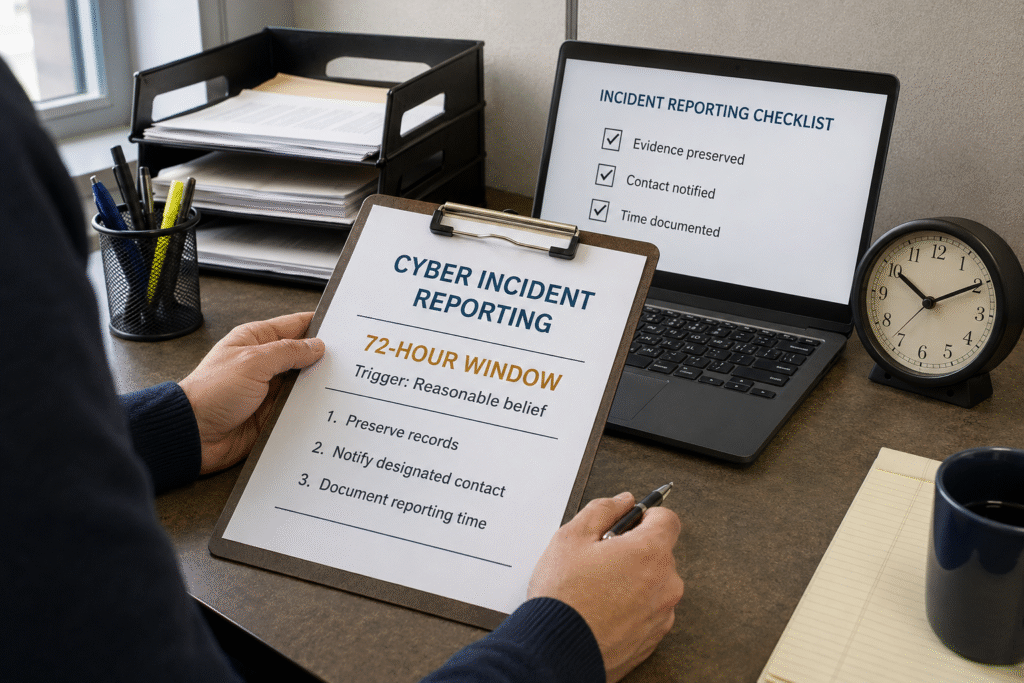
In March 2023, New Jersey enacted P.L. 2023, c.19. It requires every public agency and government contractor to report cybersecurity incidents to the New Jersey Office of Homeland Security and Preparedness, and the report must be made within 72 hours of when the agency reasonably believes an incident has occurred.
Read that clause carefully, because the trigger is earlier than people assume.
It is not 72 hours from when you confirm a breach. It is 72 hours from when you reasonably believe one may have happened. Suspicion starts the clock, not proof.
The law defines a cybersecurity incident broadly: a malicious or suspicious event on or conducted through a computer network that jeopardizes the integrity, confidentiality, or availability of an information system or the information it holds. Ransomware qualifies. So does a suspected unauthorized login. So does a phishing email that someone clicked and entered credentials into.
The coverage is wide. The law reaches municipalities, counties, K-12 public schools, public colleges and universities, state law enforcement, and private contractors doing government work.
What this actually means for a small clerk’s office
Here is the practical problem. A borough with nine employees and no IT department has, on paper, the same 72-hour duty as a state agency with a security operations center.
So what has to exist before an incident happens:
Someone has to notice. A duty you never trigger because nobody detected anything is not compliance, it is luck. This is why monitoring matters more in the public sector than almost anywhere else.
Someone has to decide. The threshold is “reasonably believes.” That is a judgment call, and it should not be made for the first time at 4 p.m. on a Friday by whoever happens to be at the desk. Decide in advance who makes that call and who backs them up.
Someone has to file. Reports go to the NJCCIC, the cybersecurity division inside NJOHSP, through their incident reporting system. Know where that form is before you need it.
The submission is protected. Worth knowing, because agencies hesitate: an incident notification submitted under this law is treated as confidential and non-public, is not subject to OPRA, and is not discoverable in civil or criminal action, with a narrow legislative oversight exception. Reporting does not create a public record of your bad day.
The state has been clear about the spirit of it too. New Jersey’s CISO, who also directs the NJCCIC, described the intent as a neighborhood watch rather than a punitive measure. The point is shared awareness, not enforcement traps. That should lower the barrier to picking up the phone early.

What else makes IT support for local government different
The reporting rule gets the headlines. Three other differences shape the work day to day.
Your network serves two populations at once
A library offers public Wi-Fi and public workstations. A municipal building has a council chamber, a tax office, and a police department that may have entirely separate requirements.
Public-facing systems have to be segmented from staff systems. Not firewalled loosely. Genuinely separated, so that a compromised public machine cannot reach the systems holding personnel records or tax data. This is the single most common gap we find when we look at a public network that grew organically.
Patron and resident privacy is not just good manners
Libraries in particular hold information about what residents read and search. That carries expectations, and sometimes obligations, that a retail business simply does not have. Retention settings, logging practices, and what the public machines remember after a session ends all become policy questions, not just technical ones.
Everything has to be documented for someone else
Auditors, governing bodies, grant administrators, and successors. In a business, undocumented work is a risk. In a public agency, it is a finding.
That means asset inventories, change records, and written procedures are part of the deliverable, not an optional extra. Any vendor you engage should be producing documentation you can hand to an auditor without translating it first.
How procurement works, briefly
New Jersey’s Local Public Contracts Law sets thresholds that determine whether a purchase can be made directly, requires quotations, or must go to public bid. Those thresholds change over time and are interpreted by your own counsel and purchasing agent, which is why we do not print numbers here.
What we do on our side is straightforward: we scope proposals so they fit cleanly into whichever track your purchasing agent tells us applies, and we provide the documentation that track requires. We have been doing public sector work in North Jersey long enough to know that a proposal which ignores procurement structure just creates work for your clerk.
If a vendor cannot talk about this comfortably, that is a signal.
A decade with Lee Memorial Library
We have worked with Lee Memorial Library for over 10 years, across consultation, design, planning, procurement, installation, maintenance, and training.
That is an unusually complete list of services to hold in one relationship, and the length is the part worth noticing. Public institutions do not renew a vendor for a decade because of a good sales meeting. They renew because the systems work, the documentation holds up, and the person who answers the phone already knows their building.
We are writing that relationship up properly as a case study, so this post plants the flag rather than telling the whole story.
What a public sector network assessment actually covers
When we assess a borough office, a library, or a small authority, we are answering five questions. They are worth knowing whether you engage us or anyone else.
What is on the network? A real inventory. Every workstation, server, switch, firewall, printer, camera system, and door controller. Public buildings accumulate connected devices from separate projects funded at separate times, and the security camera system installed under a grant in 2019 is frequently on the same flat network as the tax office.
Is public separated from staff? We test it rather than assume it. If a public workstation can reach a staff file share, that is the finding, and it is usually fixable with configuration rather than new hardware.
Is anything watching? Whether alerts exist, where they go, and whether a human reads them. An alert routed to an inbox nobody monitors is not detection.
What is out of support? Operating systems and applications past end of life. In public agencies this is common, because replacement cycles follow budget cycles rather than vendor timelines.
Who has access, and who used to? Current staff, former staff, former vendors, and the person who set up the network before the current administration. Elected turnover and staff turnover both leave credentials behind.
The deliverable is a written document your governing body can read and your auditor can accept. That last part matters more in the public sector than anywhere else, because a verbal finding does not survive a change of administration.
-
Three things to do before your next council or board meeting
You do not need a vendor to start.
Name the person who makes the call. Write down who decides that the agency reasonably believes an incident has occurred, and who does it when that person is on vacation. Put it in a policy the governing body adopts. This is the single cheapest piece of compliance available to you.
Bookmark the reporting form. Find the NJCCIC incident reporting page now, save it somewhere findable, and read the filing instructions once while nothing is happening. Reading a form for the first time inside a 72-hour window is a waste of hours you will want back.
Sign up for NJCCIC membership. It is free, it is the state’s own cybersecurity unit, and the advisories are specific to New Jersey entities rather than generic industry noise.
Those three take an afternoon combined and cost nothing. They also demonstrate, if anyone ever asks, that the agency took the obligation seriously before an incident rather than after one.
A note on shared services
Small agencies in Bergen, Hudson, and Passaic counties increasingly look at shared services agreements for technology, and it can work well. A caution worth raising early: shared arrangements need explicit clarity about who holds the reporting duty, who holds administrative access, and whose documentation an auditor receives.
The statute puts the obligation on the public agency. A shared services agreement can allocate the work. It does not move the duty. Make sure your agreement says who does what, in writing, before you need to know.
Frequently asked questions
Does the 72-hour rule apply to our contractors too? Yes. The law covers government contractors alongside public agencies, so a private firm doing work for your borough carries its own reporting duty.
What if we are not sure whether something counts as an incident? The standard is what you reasonably believe, and the definition in the statute is broad. When agencies are unsure, reporting early is the lower-risk choice, particularly given that the submission is confidential and non-discoverable.
We already have an IT vendor. Do they handle the reporting for us? Ask them directly, and get the answer in writing. The legal duty sits with the agency. A good provider will help you detect, document, and file, but the obligation does not transfer.
Do we need to be a member of anything? NJCCIC membership is free and includes advisories and threat alerts relevant to New Jersey public entities. Most agencies we work with sign up.
Is our budget too small for this? Small agencies are the ones the reporting law caught most off guard, because the duty does not scale down with headcount. The work of preparing for it is measured in days, not months.
Where to start
If your agency has not looked at this since 2023, the practical starting point is a network assessment: what you have, how it is segmented, whether anything is watching it, and who makes the call if something looks wrong.
We do that at no cost, and you keep the written findings whether or not you engage us.
Call (201) 520-2025 or request a free network assessment.
Coban Computer Solutions has served North Jersey since 2004 from Midland Park, working with public institutions and businesses across Bergen County, Hudson County, and Passaic County.
Related reading:
External references: