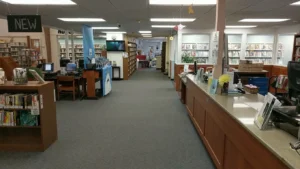
Answer up front: IT support for libraries differs from business IT in three concrete ways: the network serves patrons and staff simultaneously and must keep them separated, patron privacy carries expectations a retail business does not have, and purchases run through public procurement. We have handled all three for Lee Memorial Library for over ten years.
Most of what gets written about IT services is a pitch. This is not that. It is a look at what one relationship has actually involved over a decade, because that is more useful to another library director than any list of capabilities.
Ten years is the part worth noticing
We have worked with Lee Memorial Library for more than ten years, across consultation, design, planning, procurement, installation, maintenance, and training.
That is a wide list to hold in one relationship. Most vendor relationships cover two or three of those. Design without maintenance, or installation without training, is common. All seven is not.
But the length is the more meaningful number. Public institutions do not keep a vendor for ten years out of inertia. There are budget cycles, board turnover, staff turnover, and periodic pressure to re-bid. A decade means the systems kept working, the documentation held up when people changed, and the person who answered the phone already knew the building.
What IT support for libraries has to handle that business IT does not

One network, two populations
A law office has staff. A library has staff and the public, on the same premises, at the same time, often on the same infrastructure if nobody designed it otherwise.
Patrons need reliable Wi-Fi and working public workstations. Staff need access to circulation systems, personnel records, and administrative files. Those two things cannot touch.
Proper segmentation means a compromised public machine cannot reach anything on the staff side. Not “firewalled loosely,” genuinely separated. This is the single most common gap we find when we look at a public network that grew one project at a time, and it is usually fixable through configuration rather than new spending.
The public side also has to be resilient in a way office equipment does not. A public workstation gets used by dozens of people a day, none of whom have training, some of whom will try to install things. It needs to reset itself cleanly between sessions and it needs to be replaceable without ceremony.
Patron privacy is a professional value, not just a setting
Libraries hold information about what people read and search for. The profession has strong norms about that, and those norms have technical consequences.
What logs are kept, and for how long. What a public machine remembers after a session ends. What the Wi-Fi captures. Whether the print queue retains documents. These become policy questions that the director decides and the IT partner implements, rather than technical defaults nobody examined.
The practical version: a library should be able to answer what its systems retain about patron activity, and the answer should be a deliberate choice.
Everything has to survive a change of administration
In a business, undocumented work is a risk somebody absorbs. In a public institution, it is a finding.
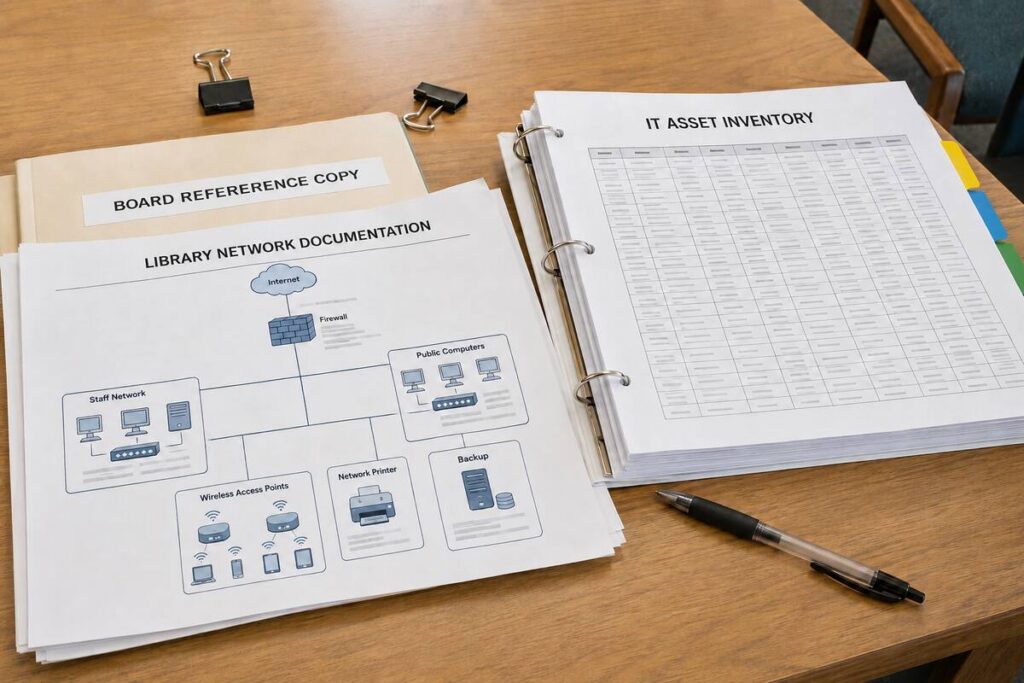
Boards change. Directors change. Auditors ask. So asset inventories, network diagrams, change records, and written procedures are part of the deliverable, not a bonus. When a new director arrives, the documentation is what tells them how the building works.
That is also what makes a ten-year relationship possible. Continuity does not come from one person’s memory. It comes from writing things down.
Procurement is a real constraint, and it is the vendor’s job to work inside it
New Jersey’s Local Public Contracts Law sets thresholds that determine how a purchase can be made. Your purchasing agent and counsel interpret those, not your IT vendor.
What a good vendor does is scope proposals to fit whichever track applies and provide the documentation that track requires, so the process does not create extra work for the clerk. A proposal that ignores procurement structure is a proposal that gets sent back.
The seven services, in plain terms
Consultation. Working out what the library actually needs before anything gets bought. Most of the money saved in a public IT relationship is saved here.
Design. Deciding how the network is laid out, especially where public and staff sides separate.
Planning. Sequencing work around budget cycles, grant timing, and the library’s calendar. You do not do infrastructure work during a summer reading program.
Procurement. Specifying equipment so it fits the purchasing process, and documenting it accordingly.
Installation. The physical work, done in a way that leaves the next person a diagram rather than a mystery.
Maintenance. Ongoing monitoring, patching, and the boring reliability work that makes a decade possible.
Training. Staff who can handle routine issues themselves, which is what keeps a small support relationship affordable.
Why this matters more since 2023
New Jersey now requires public agencies to report a suspected cybersecurity incident to the state within 72 hours of reasonably believing one occurred. Libraries are covered.
That obligation only works if someone notices, someone is authorized to make the call, and someone knows where to file. We covered the mechanics in detail in the post on IT support for local government, and this is where a long relationship pays off in a way a new vendor cannot match: knowing a network well enough to recognize when something is wrong is not something you can install.
What a decade actually looks like, year to year
Not a timeline of projects, because that would be a brochure. The honest version of a long public sector relationship is that it has three modes, and most of the time it is in the third one.
Project mode. A refresh, a rewiring, a migration. Visible, budgeted, scheduled well in advance around the library’s calendar and the funding cycle. This is maybe a few weeks a year.
Response mode. Something broke. A switch, a workstation, a printer that half the building depends on. Hours to a day, a few times a year in a well-maintained environment.
Quiet mode. Everything else. Patching, monitoring, backup verification, answering a staff question, checking that the thing installed three years ago is still doing what it was supposed to.
Quiet mode is where the value is, and it is the hardest thing to sell, because a year in which nothing happened looks identical on an invoice to a year in which nothing was done. The difference only shows up when something goes wrong somewhere else and you notice it did not go wrong here.
That is worth saying plainly to any board evaluating an IT relationship: the absence of incidents is the product.
Three things any NJ library can do without hiring anyone
If you are a director reading this and not in a position to engage a vendor, these three cost nothing and address the most common gaps we find.
Test whether public and staff systems are actually separated. Sit at a public workstation and try to reach a staff file share or the circulation system’s admin interface. If you can, that is the finding, and it is the most important one on this page.
Pull the list of who has administrative access. Read every name. Former staff, former directors, former vendors, and the person who set up the network under a previous administration all tend to appear. Removing them is free.
Write down who decides. One page naming who is authorized to disconnect the network, who makes the call that an incident has occurred, and who backs each of them up when they are away. Adopt it formally so it survives turnover.
None of these require budget. All three take an afternoon, and together they close the gaps that show up most often when we assess a library or municipal network for the first time.
Frequently asked questions
Is IT support for libraries more expensive than business IT? Not inherently. The work is differently shaped rather than larger. Segmentation and documentation take real effort up front; public workstations are often simpler and cheaper to maintain than staff machines once set up correctly.
We are a small library with no IT staff. Where do we start? An assessment. What is on the network, whether public and staff are separated, what is out of support, and who has access. Those four answers determine everything else, and none of them require spending money to obtain.
Can a library use cloud services given patron privacy concerns? Generally yes, with attention to what each service retains and where. The question is not cloud versus not-cloud, it is whether you can state what is kept and for how long.
Does a shared services agreement with the municipality cover this? It can cover the work. It does not move the legal obligation, which sits with the agency. Make sure your agreement says explicitly who does what.
How do we handle a vendor transition without losing institutional knowledge? Insist that documentation belongs to the library, in writing, at the start of the relationship rather than the end of it.
If you run a library or a public institution in North Jersey
We offer a free network assessment for public institutions. What is on your network, whether public and staff systems are properly separated, what is past end of support, and who still has access.
You keep the written findings whether or not you work with us, and they are written to be handed to a board or an auditor without translation.
Call (201) 520-2025 or request an assessment.
Coban Computer Solutions has served North Jersey since 2004 from Midland Park, working with public institutions and businesses across Bergen, Hudson, and Passaic Counties.
Related reading:
External references: